
A Walk Through Middle-earth: From the Shire to Lothlórien
From the Shire and Bree to the Grey Havens and Dunland, these Middle-earth locations from The Lord of the Rings offer rich Tolkien lore.
I have always loved staring at a giant map of Middle-earth. It feels like planning a road trip through a world that somehow exists just beyond the edge of the page. Before I get into my favourite stops, let me set the stage. Middle-earth is only one continent in Arda, which sits inside Eä, the universe dreamed up by J.R.R. Tolkien. The creator, Eru Ilúvatar, first made spirit beings called the Ainur. Their great music, the Ainulindalë, became the blueprint for everything. The 15 most powerful Ainur, the Valar, entered Eä along with lesser spirits called Maiar to build what they had sung into being. One of them, Melkor, later known as Morgoth, rebelled and caused ages of war before he was finally cast into the void. That long history shaped the intricate world we see in The Lord of the Rings.
Now, if I had to start anywhere, it would be the Shire. This is the home of Frodo Baggins, Samwise Gamgee, Merry Brandybuck, Pippin Took, and Bilbo Baggins. It practically smells like warm bread and pipe-weed. The Shire sits in Eriador, the big western region stretching from the Blue Mountains to the Misty Mountains. It used to be part of Arnor, which later split into Arthedain, Cardolan and Rhudaur. Hobbits arrived in the year 1150 of the Third Age, and by T.A. 1601 they had agreed the Shire's borders with King Argeleb II of Gondor. The Shire is divided into four Farthings: North, South, East and West. Bag End, the most famous hobbit-hole, is in Hobbiton in the Westfarthing. Tookland is also in the Westfarthing, while Buckland lies east of the Brandywine River. The East and West Marches sit outside the Farthings, and the Westmarch lies to the west.
Just east of Buckland, right off the Great East Road, is Bree. I find Bree fascinating because it is one of the oldest spots in the region. It was the chief village of Bree-land, and its people claimed to be the first smokers of pipe-weed. That feels like a very important cultural milestone. Bree is also unusual because Hobbits and Men lived together there, with the Men of Bree having settled in the Elder Days before the Second Age.
Then there is the Grey Havens, or Mithlond. Ruled by Círdan the Shipwright, the oldest Elf in Middle-earth during the Third Age, this western port is where ships sail to Aman. Aman had been removed from the Circles of the World in the Second Age, so only the Straight Road can take you there. The realm of Valinor, home of the Valar, is Aman's most famous land. The Grey Havens formed after the War of Wrath sank Beleriand. The Blue Mountains split, water rushed in, and the Gulf of Lhûn was created. The remnant of Beleriand, called Lindon, lies above and below the gulf to the west.
Skipping south, Dunland is a place I used to overlook. It sits at the southern edge of Eriador and is home to the Dunlendings. In The Two Towers, Saruman uses them against Rohan. Their conflict with the Rohirrim goes back to a land dispute after Gondor gave the area to Rohan. The Dunlendings descended from the Haladin, a reclusive house of the Edain who did not side with Morgoth. They settled Dunland in the Second Age while fleeing Númenórean colonization. That history of being pushed around explains a lot.
Rivendell is next, and it is hard not to love this hidden valley. Elrond founded it in S.A. 1697 while fleeing Sauron's forces after Eregion fell. Protected by Elrond and his Ring of Power, Vilya, Rivendell became one of the greatest Elvish strongholds. Aragorn was fostered there from T.A. 2012, which is how he met Arwen, Elrond's daughter. That little detail makes the place feel even more important.
Moria, or Khazad-dûm, is another personal favourite. This Dwarvish colony was founded by Durin the Deathless in the Elder Days. The Dwarves were made by Aulë the smith, one of the Valar, and given life by Eru with the Imperishable Flame. Durin was the first of the Seven Fathers of the Dwarves. His people ruled Khazad-dûm until they dug too deep and woke a Balrog in T.A. 1981. Balin tried to reclaim it in T.A. 2989, but Orcs took it in T.A. 2994. It was finally resettled by Durin VII in the Fourth Age.
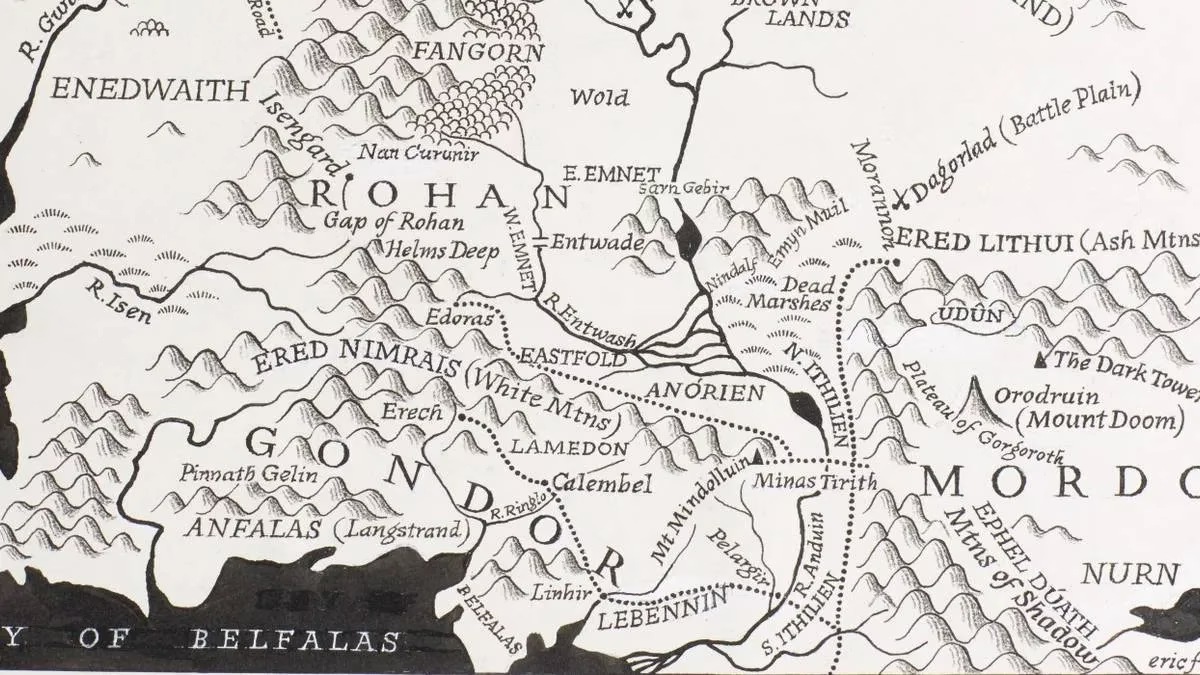
Fangorn Forest and Isengard sit near the southeastern end of the Misty Mountains. Fangorn is the realm of the Ents, and Treebeard guides Merry and Pippin through it in The Two Towers. It is the eastern remnant of a much larger Elder Days forest that was devastated by Númenórean expansion. Isengard, with its great tower Orthanc, was built by early Gondorians after the fall of Númenor. Gondor and Rohan welcomed Saruman's offer to manage it, but he filled it with Orcs and Uruk-hai. The Ents eventually took it back during the War of the Ring.
Mirkwood and Lothlórien complete my tour. Mirkwood was originally Greenwood the Great. It may have connected to the Old Forest in Eriador during the Elder Days. Thranduil, Legolas' father, ruled there in the Third Age. When Sauron built Dol Guldur in the southern part, the forest grew dark and dangerous. After Sauron's fall, Galadriel and Celeborn conquered Dol Guldur and divided the forest among Thranduil, the Beornings and the Woodmen. They renamed it the Wood of Greenleaves. Lothlórien, just east of the Misty Mountains, was first occupied by Nandor Elves and later ruled by the Sindar Elf Amdir and his son Amroth. Galadriel and Celeborn assumed leadership in the Third Age, turning it into the golden, timeless realm we see in the story.
Here is a quick cheat sheet if you ever plan your own Middle-earth trip:
| Place | Who You Might Meet | Why It Matters |
|---|---|---|
| The Shire | Hobbits, mostly Tooks and Brandybucks | Peaceful heart of the story |
| Rivendell | Elrond, Arwen, Aragorn | Hidden Elvish refuge |
| Moria | Durin's folk, a Balrog | Greatest Dwarf realm gone dark |
| Mirkwood | Thranduil, giant spiders | Sauron's shadow turned it wild |
| Lothlórien | Galadriel, Celeborn | Golden forest protected by a Ring of Power |
I love that these places are not just dots on a map. Each one carries thousands of years of history, migration, war and resilience. The map of Middle-earth feels alive because Tolkien gave every forest, mountain path and river a reason to exist. That is why I can spend hours tracing the road from Bag End to the Grey Havens and still feel like I am heading home.