
Behind the Scenes: How Emilia Pérez’s Globe-Spanning Story Was Shot Almost Entirely in Paris
The Netflix crime musical Emilia Pérez filmed its globe-trotting plot entirely in Paris, not Mexico or Bangkok.
Although I usually spend my days dissecting level design and speedrun strategies, the real-world production of Jacques Audiard’s genre-defying Emilia Pérez hooked me like a perfectly paced boss fight. The Netflix crime musical bounces across Mexico City, Bangkok, Tel Aviv, Lausanne, and London, yet almost all of it was captured in a single country – and not one you’d expect. How did a film with such a sprawling passport end up so geographically compact? Let’s break down the ingenious location magic that turned Parisian studios into a global stage.
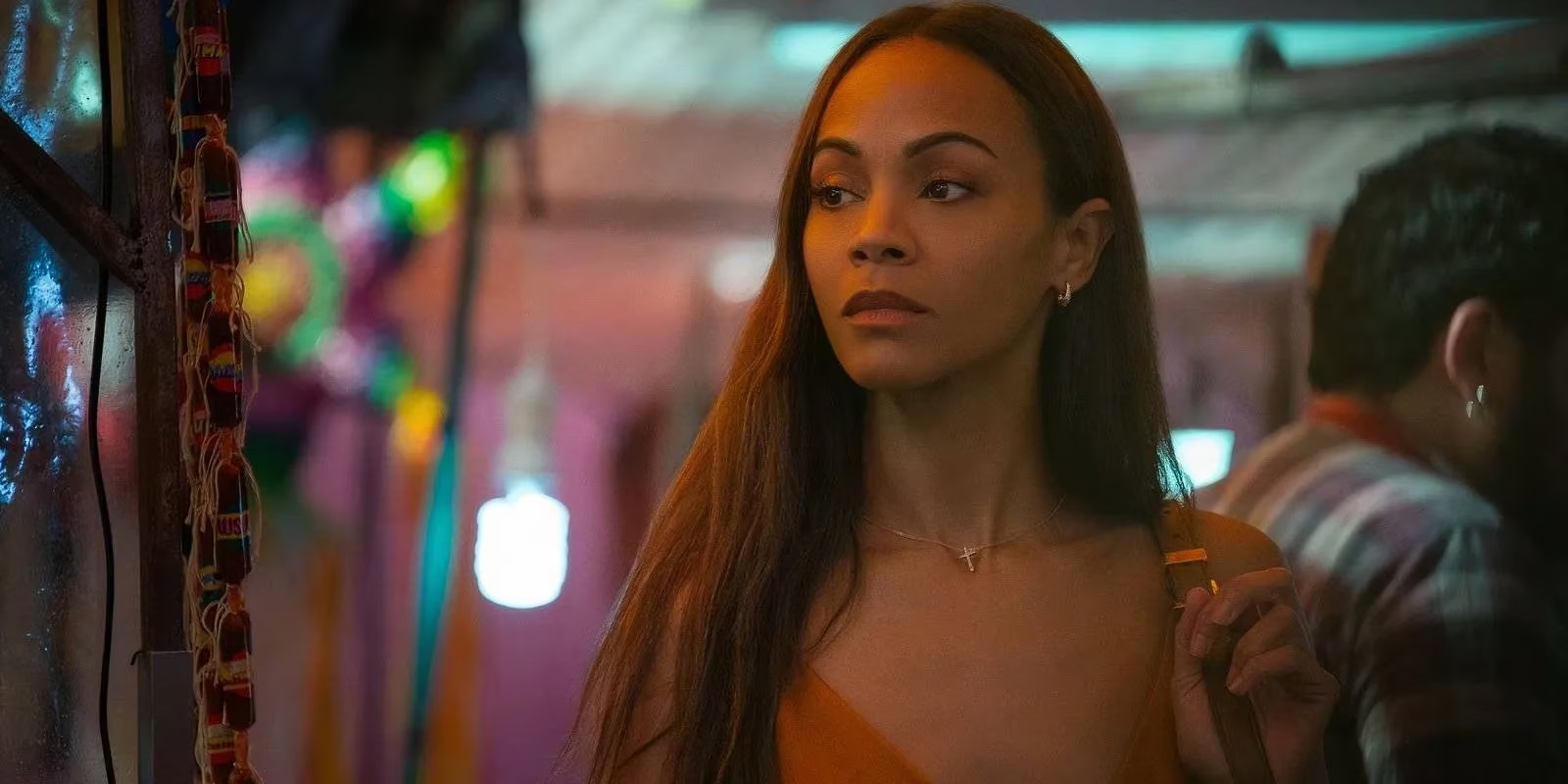
I first caught Emilia Pérez after it stormed the 2024 Cannes Film Festival, winning the Jury Prize and the Best Actress Ensemble award. Since then, it’s only grown in stature. At the 97th Academy Awards in March 2025, Zoe Saldaña took home the Oscar for Best Supporting Actress – a towering performance matched by the film’s win for Best Original Song. Even now, in 2026, the movie remains a standout on Netflix, still sparking debates about its bold blend of cartel drama, heartfelt transitions, and earworm musical numbers. For a story so rooted in specific locales, the absence of globe-trotting shoots is both a testament to crafty filmmaking and a question many viewers don’t think to ask: where was Emilia Pérez actually lensed?
🌎 The Story’s Map vs. the Real-World Set
The plot revolves around Rita (Saldaña), a Mexico City defense lawyer hired by cartel kingpin Manitas Del Monte (Karla Sofía Gascón) to facilitate a secret gender-affirming transition. On screen, the journey leaps across continents:
-
Mexico City, Mexico – The heart of the narrative, where Rita first meets Manitas and where Emilia later returns to reunite with her family.
-
Bangkok, Thailand – Rita flies here to consult a surgeon and understand the medical roadmap.
-
Tel Aviv, Israel – Dr. Wasserman performs the actual surgeries in this emotionally charged section.
-
London, England – Post-transition Rita enjoys a lavish new life; it’s also where she encounters Emilia in her new identity for the first time.
-
Lausanne, Switzerland – Emilia’s ex-wife Jessi and their children are relocated to this peaceful lakeside town before Rita brings them back to Mexico City.
But here’s the twist that felt almost like an Easter egg when I dug into the production details: none of these countries hosted the main cast for filming.
🎥 Paris, France: The Unlikely Backlot

Audiard, known for works like Rust and Bone and The Sisters Brothers, orchestrated the vast majority of Emilia Pérez inside soundstages and backlots in Paris. The director’s familiarity with French studio infrastructure allowed his team to build evocative interiors and adaptable streets that convincingly doubled for multiple nations. This isn’t just guesswork – production notes confirm that Paris served as the lone filming hub for the core scenes.
Does that mean Mexico never saw the crew? Not entirely. A locations scout for Mexico, Diego Fernando Diosa (who worked on Narcos), is credited, hinting that some exterior establishing shots or the early choreographed street sequences might have been captured on location. At the very least, a handful of landscape inserts could be genuine Mexican terrain. But every time we see Saldaña striding through a busy thoroughfare or Gascón confronting her past in what looks like a Mexican street, we’re likely staring at a meticulously dressed set just outside the studio gates – or a clever composite.
This approach reminds me of how game developers reuse assets to build seemingly vast worlds in tight memory budgets. Audiard and his design team crafted modular “lives” for each city: a Bangkok office with humid, golden lighting; a Tel Aviv clinic with sterile, cool tones; a London flat overlooking stylized gray skies. The choreography, especially the opening street number, benefited from the controlled environment, allowing the camera to dance freely without permits, weather, or unpredictable crowds.
🎬 Why Shoot This Way?
-
Budget efficiency: With a reported budget of roughly €25 million ($26.9 million), flying a large cast and crew across five countries would have been a logistical nightmare. Soundstage work kept costs predictable.
-
Creative control: Audiard wanted precise lighting and color palettes to underline each location’s emotional purpose – something far easier to achieve in a studio than on hectic city streets.
-
Continuity: The non-linear story demanded consistent visual callbacks. Building sets guaranteed repeat visits looked exactly the same.
🏆 The Oscar Glory and Lasting Impact

Coming back to 2026, it’s hard to overstate how Emilia Pérez reshaped conversations around representation in musical cinema. Its Academy Award victories for Best Supporting Actress and Best Original Song turned it into a cultural touchstone, and Gascón’s historic nomination as the first openly trans actress in the category still resonates. For a film that never left Europe to capture its Mexican, Thai, Israeli, Swiss, and English backdrops, the authenticity it projects is a triumph of production design and immersive performance.
Does knowing that Paris played Mexico City change your perception? I’d argue it elevates the craft. Every brick wall, every street vendor stall, every sterile hospital corridor was a deliberate choice, transforming soundstage 5 into any corner of the world the script demanded. Next time you watch Emilia Pérez, try to spot the seams – you might just find a new respect for the invisible art of filmmaking. And as a gamer who loves how interactive worlds are stitched together from reusable pieces, I can’t help but tip my hat to Audiard’s high-level art direction. It’s a flawless speedrun through global cinema without ever leaving the home base.