
Exploring the Real Italian Villages and Movie Magic Behind Netflix's La Dolce Villa
Discover the enchanting filming locations of Netflix's La Dolce Villa in Italy, blending Tuscany's charm with Lazio's cinematic magic.
When I first watched Netflix's La Dolce Villa, I was immediately swept away by its picturesque Italian setting. The story of Olivia buying a crumbling villa and her father Eric's reluctant journey to stop her is charming, but it's the breathtaking backdrop that truly captured my heart. The entire premise hinges on Italy as a land of dreams, inspiration, and romantic possibility. But as I marveled at the rolling hills and sun-drenched villages, I couldn't help but wonder: where exactly was this cinematic postcard brought to life? Was it all filmed in one perfect, hidden town, or is there more movie magic at play than meets the eye?
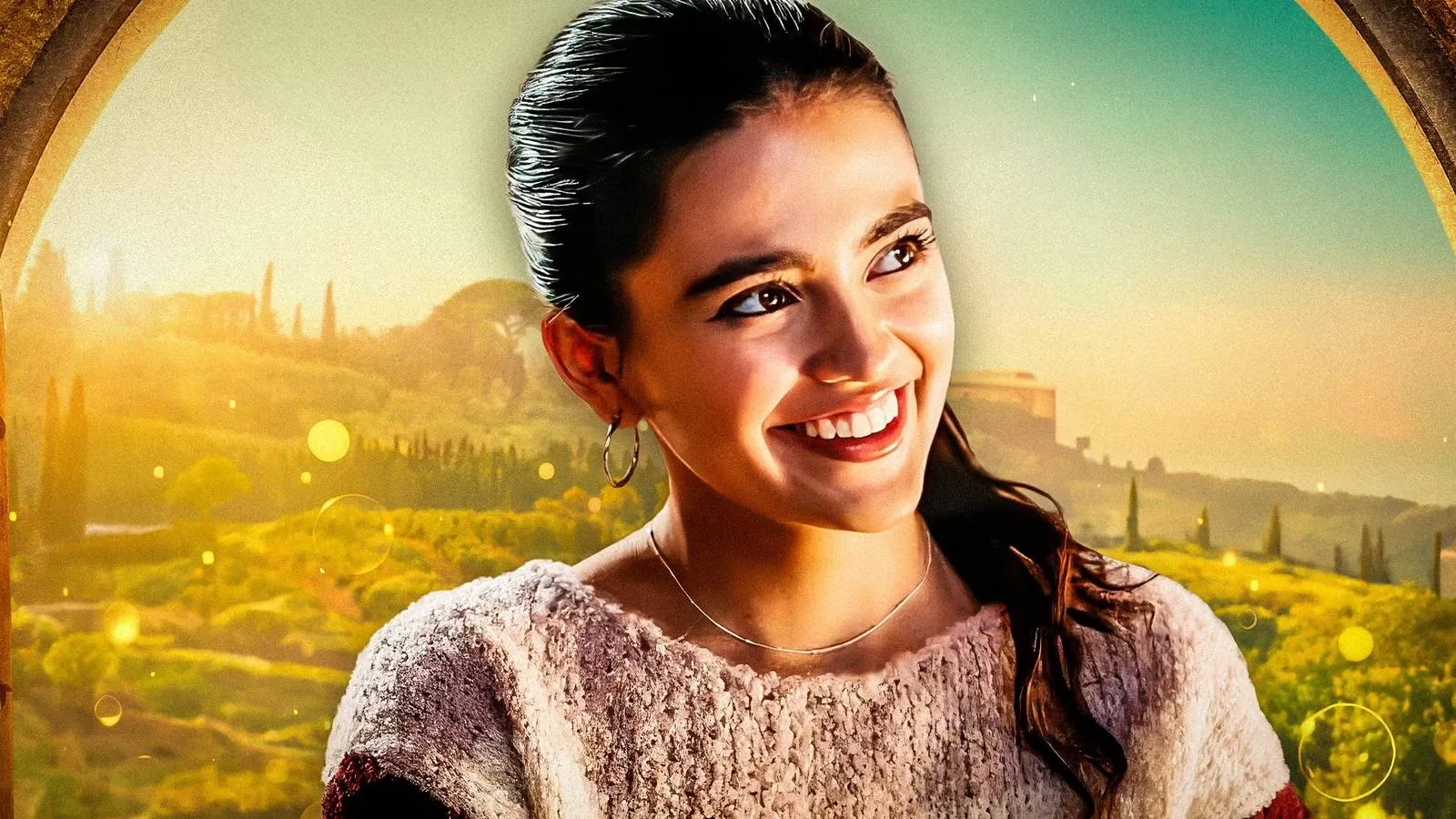
The heart of the film beats in the fictional town of Montezara, Olivia's chosen project and the setting for most of the story. Montezara is portrayed as a charming yet struggling village, a perfect metaphor for Olivia's own ambitious restoration project. To my surprise, I discovered that this idyllic spot isn't a real place on a map. Instead, director Mark Waters and his team found its perfect real-world counterpart in San Quirico D’orcia, a tiny commune in the heart of Tuscany with only about 2,500 inhabitants. Waters explained that this was the ideal choice because it possessed that specific blend of run-down charm and authentic small-town struggle he envisioned. Unlike the more polished and tourist-heavy towns like Siena, San Quirico D’orcia felt real and lived-in. It was the perfect canvas to depict a village where someone might actually buy a one-euro villa in hopes of revitalizing the community. The production even added elements like a fountain and new storefronts to enhance the town's cinematic appeal without losing its genuine character.

However, the film's most iconic location—Olivia's villa itself—wasn't found in Tuscany. The exterior shots of the beautiful, crumbling property were filmed in a different region altogether: San Gregorio da Sassola. This village, located in East Lazio just 45 minutes from Rome, is even smaller than San Quirico D’orcia, with a population of around 1,600. It provided the perfect hillside vista and that specific, cascading architecture of off-white buildings that look like ancient castles. This choice highlights the practical realities of filmmaking; the perfect villa exterior simply didn't exist in the primary filming town. So, the production utilized the unique charm of San Gregorio da Sassola to give Olivia's dream a physical home. Isn't it fascinating how a single character's home in a movie can be a composite of different real-world locations?
This leads me to one of the most impressive feats of La Dolce Villa's production. While the villa's exterior is in San Gregorio da Sassola, all of the interior scenes were shot on a soundstage. And not just any soundstage—they were filmed at the legendary Cinecittà Studios in Rome. As a film enthusiast, this blew my mind. Cinecittà is Europe's largest film studio, a historic complex with a legacy spanning from classic Italian cinema to major Hollywood blockbusters like Gangs of New York. The fact that the cozy, lived-in interior of the villa was constructed on a set, yet feels seamlessly connected to the exterior shots filmed hours away, is a testament to incredible set design and cinematic illusion. It proves that even a seemingly straightforward romantic comedy employs sophisticated techniques to build a believable world.
To ground Eric's journey in reality, the film also features a very recognizable real-world location: The Roma Trastevere Railway Station. This brief but important scene, where Eric first arrives in Italy, adds a layer of authenticity. It reminds us that he doesn't just teleport into this romantic fantasy; he travels there like any ordinary person, stepping off a train into the bustling heart of Rome before making his way to the quiet countryside. This subtle detail helps bridge the gap between the audience's world and the film's idyllic setting.
So, what does the filming journey of La Dolce Villa ultimately show us? Let me break it down:
-
The Fictional Heart: Montezara = San Quirico D’orcia, Tuscany (population ~2,500). Chosen for its authentic, slightly struggling charm.
-
The Dream Villa's Exterior: Located in San Gregorio da Sassola, Lazio (population ~1,600). Chosen for its perfect hillside architecture and available property.
-
The Dream Villa's Interior: Constructed on sets at Cinecittà Studios, Rome. Europe's largest film studio handled all interior scenes.
-
The Touch of Reality: Roma Trastevere Railway Station was used for Eric's arrival, adding a layer of authentic travel.
In the end, La Dolce Villa is more than a sweet story about family and romance. For me, it acts as a captivating visual travel guide, showcasing not just the iconic Rome but highlighting the understated beauty of Italy's lesser-known rural gems. It’s a reminder that the magic of cinema often lies in the clever fusion of real places and crafted illusions, all coming together to create a world we wish we could visit. As of 2026, the film continues to inspire viewers to look beyond Italy's famous cities and explore the serene, storybook landscapes of villages like San Quirico D’orcia. Who knows? Maybe after watching, you'll be tempted to see if there are any one-euro villas left waiting for their own restoration story.