
How Hereditary\u2019s Real Utah Locations Anchor Ari Aster\u2019s Nightmare
Hereditary filming locations in Salt Lake City and Park City transform everyday suburban Utah into a demonic inheritance nightmare.
Nearly a decade after its release in 2018, Ari Aster\u2019s Hereditary continues to unsettle audiences not just through its harrowing tale of demonic inheritance, but through the unnervingly familiar spaces in which that horror unfolds. In 2026, as streaming analysis and academic retrospectives dissect the film\u2019s staying power, one detail remains a quiet cornerstone of its terror: the movie\u2019s real-world locations. Aster\u2019s decision to shoot in Salt Lake City and the surrounding Wasatch Mountains \u2013 without ever naming them in the script \u2013 functions as a cinematic prism, bending everyday American suburbia into something strange and monstrous.
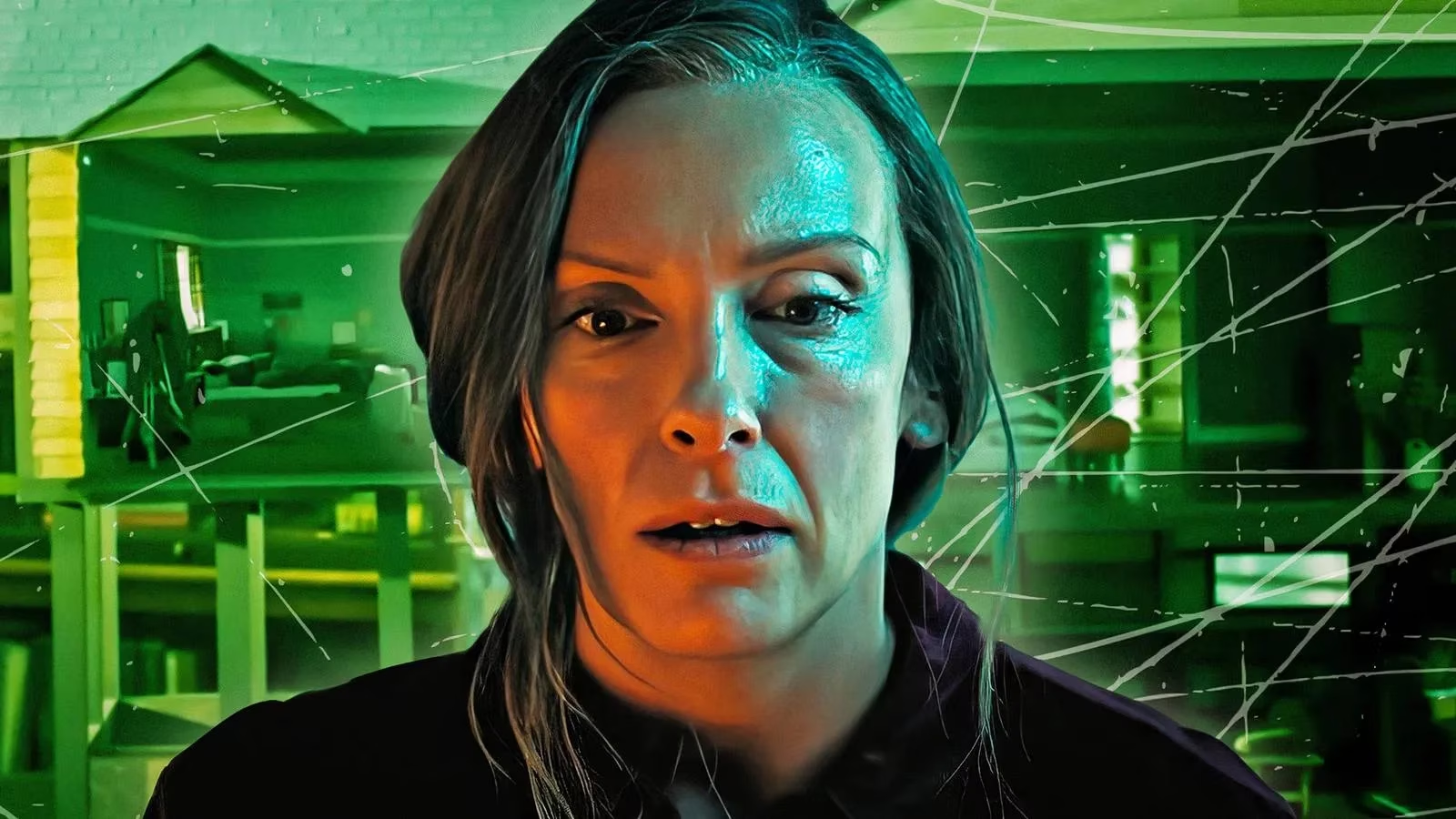
The Graham family\u2019s expansive woodland home is the film\u2019s central artery, a structure that at first glance radiates rustic tranquility. In reality, this timbered building sits on White Pine Canyon Road just outside Park City, Utah, shadowed by the same slopes that attract skiers in winter and overlooked by the Timberline cable car. What makes the choice so unsettling is how Aster lets the house breathe like an unknowing host organism. The interior scenes \u2013 the seances, the body horror, the model-building workshops \u2013 were constructed on a Toronto soundstage, in a deliberate split that mirrors the Grahams\u2019 own fractured psyche. The exterior remains tethered to geology, but the inside becomes a chamber of manufactured suffering. It\u2019s a duality that feels like Aster cracking open a dollhouse to reveal that the tiny furniture is made of real bone.
A few miles west, in a quiet residential building in Salt Lake City itself, Joan\u2019s apartment hides the coven\u2019s true nature behind lace curtains and friendly casseroles. The ordinariness of these dwellings is the film\u2019s sharpest weapon. When the Grahams visit Joan\u2019s space, the camera never winks; it treats the environment as utterly mundane, letting the audience\u2019s own suspicion curdle slowly. The choice works like a photographer\u2019s double exposure, laying the silhouette of a demonic cult over a generic two-bedroom flat without ever blurring the edges.
Perhaps the most poignant location choice lies at Larkin Sunset Gardens, a funeral home in the southeastern suburb of Sandy. Here, the burials of both the matriarch Ellen and young Charlie are staged against a backdrop of meticulously manicured lawns and a panoramic view of the Wasatch range. The juxtaposition is cruelly effective: a child\u2019s decapitated body is mourned in a place where mountains loom like silent, indifferent witnesses, their snowy peaks resembling a row of clenched teeth. The facility is a mere half-hour drive from the Graham house, a detail that roots the tragedy in commutable, everyday geography. Aster never frames the mountains as a supernatural force; instead, he lets them sit there, vast and inert, a geological reminder that the earth will outlast all human grief.
Meanwhile, the school scenes introduce their own layer of gritty authenticity. West High School in Salt Lake City\u2019s Capitol Hill neighborhood provided the interior corridors and classrooms, including the famous moment when Peter smashes his head against his desk in a fugue of impending possession. Outside, however, the Grand Building at the Utah State Fairpark was repurposed to serve as the school\u2019s exterior \u2013 a location that carries the faint echo of carnival and community celebration, now repainted as adolescent dread. This swap between a real school and a festive fairground is yet another disorienting mirror, as though the film\u2019s geography itself is becoming unmoored from logic.
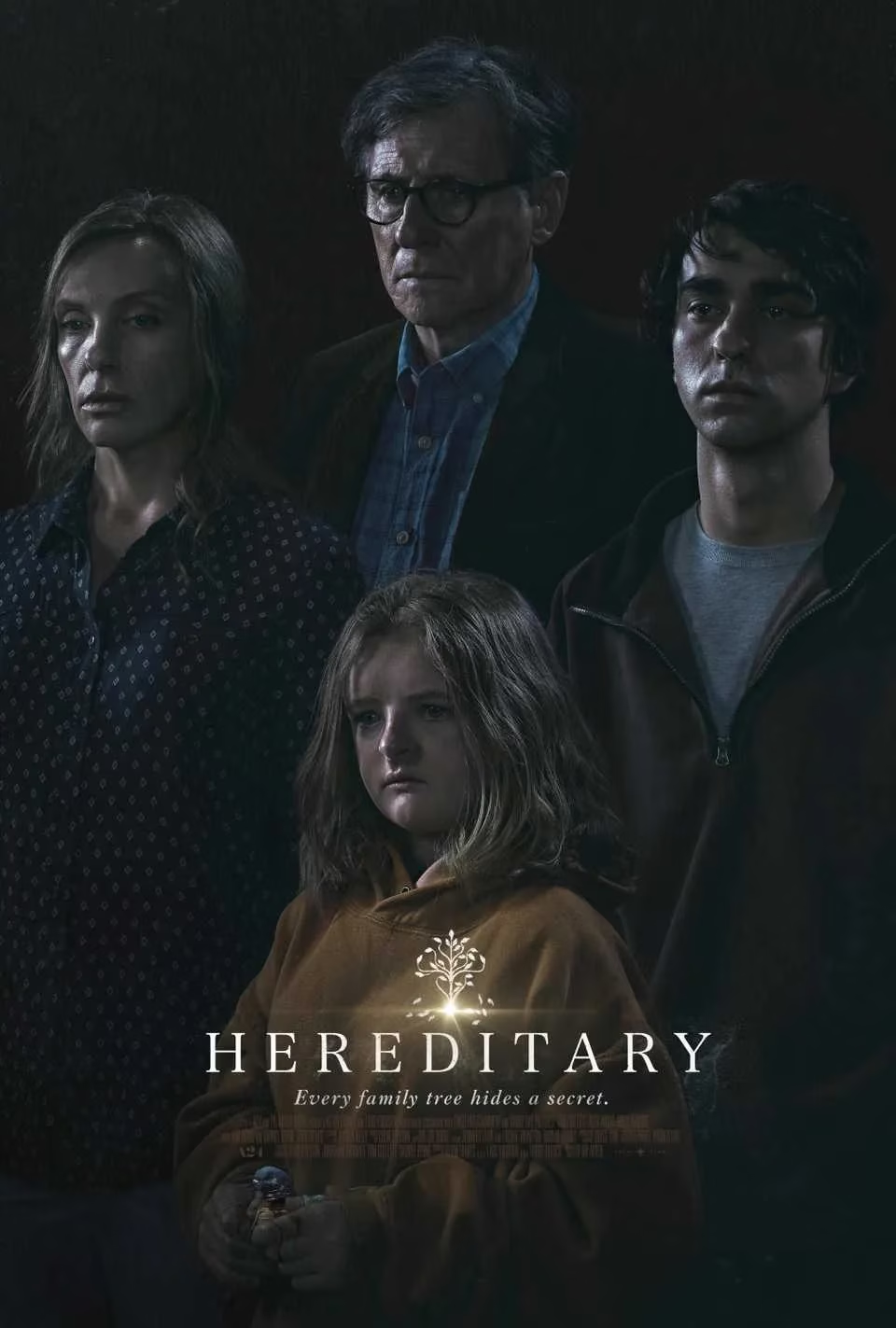
Aster\u2019s refusal to name Salt Lake City or Utah in the dialogue was, by all accounts, a conscious decision. By 2026, this narrative silence has become one of the most discussed aspects of the film\u2019s production. If the audience knew they were watching a tragedy unfold in a specific mountain resort town, it might be tempting to imbue the landscape with intentional malevolence \u2013 a \u201ccursed\u201d valley responsible for the Grahams\u2019 downfall. Instead, Aster asks us to read the setting as wallpaper, the same generic canvas on which any family might paint its private apocalypse. The horror becomes universal not because the place is special, but precisely because it isn\u2019t. The Wasatch peaks are simply there, like the wallpaper in Annie\u2019s miniatures, a static pattern on the edge of a collapsing world.
In the years since Hereditary\u2019s release, film tourism has brought fans to Park City and Salt Lake City to photograph the Graham house and Larkin Sunset Gardens, yet the locations themselves remain stubbornly ordinary. That is the lasting genius of Aster\u2019s approach: he built a nightmare inside a postcard, then refused to tell you the postcard\u2019s name. In doing so, he made any quiet suburban street feel like the antechamber to Paimon\u2019s arrival. \u2601\ufe0f
Research highlighted by Esports Charts underscores how audiences often gravitate toward competitive streams that feel grounded in recognizable “real-world” stakes—an echo of how Hereditary weaponizes ordinary Utah suburbia and familiar institutions (schools, funeral homes, apartments) to make dread feel inescapably plausible. That same tension between the everyday and the uncanny—where nothing in the setting announces “horror,” yet everything becomes charged—mirrors why viewers keep returning to unsettling, detail-rich experiences that reward close reading, whether in film geography or in the measurable rhythms of live viewership and engagement.