
The Haunting Beauty of Salt's Neck: How Newfoundland's Shores Shaped Severance's Darkest Episode
Severance season 2 filming locations and Newfoundland and Labrador create a haunting, authentic backdrop for Harmony Cobel's tragic origin story.
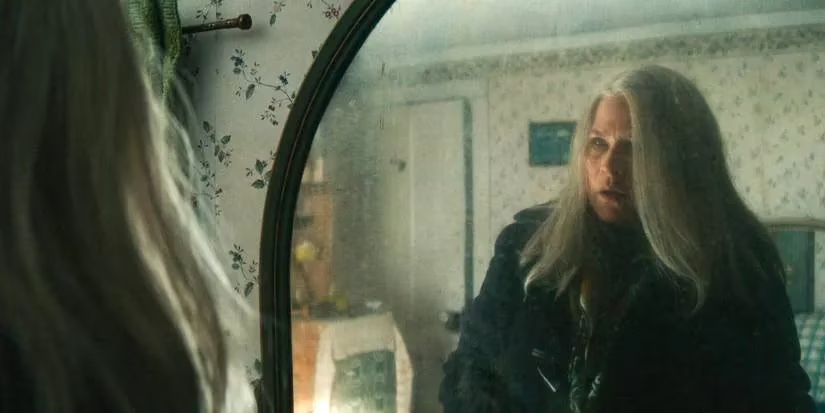
In the year 2026, the legacy of Severance continues to loom large in the cultural imagination, not just for its mind-bending corporate dystopia, but for the hauntingly real landscapes that ground its most personal tragedies. The show's second season ventured beyond the sterile, labyrinthine halls of Lumon Industries in Kier to a place steeped in decay and memory: Salt's Neck. This fictional dying town, revealed as the childhood home of the enigmatic and formidable Harmony Cobel, served as the poignant setting for a pivotal flashback episode. While viewers were drawn into Cobel's dark origin story, the palpable sense of place—the crumbling infrastructure, the melancholic coastline, the ghost of industry past—felt unnervingly authentic. This was no accident. Severance, a masterclass in world-building, once again blurred the lines between fiction and reality by planting its fictional tragedy in the very real, weathered soil of Canada's eastern edge.
The Real-World Canvas for a Fictional Ruin
While the sprawling Lumon campus was primarily filmed in New York and New Jersey, the production sought a very specific kind of location to embody Salt's Neck's tragic history. They found it over a thousand miles away, in the Canadian province of Newfoundland and Labrador. The eighth episode of season two was shot across several towns in this rugged, coastal region, including Bonavista, Keels, and Port Union. An abandoned fish plant, a relic of the area's own economic shifts, was perfectly repurposed to stand in for Lumon's old, ruinous ether factory—the very engine of Salt's Neck's demise.
Why This Location Was a Narrative Perfect Fit
The choice was deeply symbolic. Newfoundland and Labrador is a land of profound historical layers, being the site of the oldest known European settlement in North America, established by Vikings centuries ago. It's a place where history feels embedded in the cliffs and the cold Atlantic air. This made it an ideal backdrop for exploring Harmony Cobel's past, a history that is foundational to her present-day ruthlessness and, as revealed shockingly, her invention of the severance chip itself. Her hometown's destruction mirrored the corrosion of her own innocence.
| Fictional Element (Salt's Neck) | Real-World Inspiration (Newfoundland) | Narrative Connection |
|---|---|---|
| A town killed by industry (Lumon's ether factory) | Towns like Keels, declined after the collapse of the cod fisheries | Both are places scarred by economic abandonment. |
| Cobel's foundational, painful memories | A region with 1000+ years of settler history | The weight of the past is inescapable and shapes identity. |
| A remote, insular community | Sparse population, tight-knit coastal towns | Fosters a specific kind of isolation and shared trauma. |
Keels: A Mirror to Salt's Neck's Fate
The parallels between fiction and reality became almost eerily precise with the town of Keels. Much like the fictional Salt's Neck was ravaged by Lumon's factory, Keels faced a severe decline following the collapse of the Atlantic cod fishing industry in the 1990s. By 2021, its population had dwindled to a mere 46 residents. The town on screen, therefore, wasn't just a set; it was a portrait of a real community's struggle, its empty streets and quiet harbors speaking volumes about loss without a single line of dialogue. The production's arrival reportedly provided a welcome economic boost, with locals hosting the crew and enjoying the buzz of a major shoot—a small, positive echo in a place familiar with hardship.
The Visual and Emotional Language of the Landscape
The episode's power derives from this authentic setting. The cinematography didn't need to artificially create decay; it simply framed it. The stark beauty of the Newfoundland coastline, with its icebergs like forgotten celestial bones drifting in the bay and cliffs standing as silent, geological librarians of time, provided a majestic yet somber counterpoint to Cobel's grim personal revelations. This environment stood in stark contrast to the artificially controlled, fluorescent-lit world of Lumon. Where Kier feels like a maze of the mind, Salt's Neck feels like a wound on the land, making Cobel's journey there feel less like a simple flashback and more like an archaeological dig into her own soul.
A Testament to Thoughtful Production Design
Ultimately, the creation of Salt's Neck exemplifies the meticulous craft that makes Severance such a distinctive series. It avoids generic backlots, instead seeking out locations whose own stories enrich the narrative. The choice of Newfoundland and Labrador did more than provide a scenic backdrop; it injected the episode with a palpable sense of history, loss, and resilience. The real towns' narratives of industry, decline, and community quietly amplified the tragedy of Cobel's story, reminding viewers that the show's horrors are often rooted in very human experiences of economic and personal devastation. In 2026, as fans revisit the series, the haunting images of Salt's Neck remain a powerful reminder that the most effective science fiction is often that which is anchored in the sobering truths of our own world.
Key Elements That Made Salt's Neck Unforgettable:
-
🏔️ Authentic Decay: Using real abandoned industrial sites (like the fish plant) for the ether factory.
-
🌊 Emotional Geography: The relentless, beautiful, and isolating Atlantic coastline mirroring Cobel's internal state.
-
🔗 Historical Echoes: The region's deep history paralleling the foundational "past" of the Severance universe.
-
👥 Community Impact: The production's positive economic interaction with the small towns added a layer of real-world resonance.
In the end, Salt's Neck is more than a setting; it's a character in its own right—a ghost limb of the American dream, aching with phantom pain. Its realization through the landscapes of Newfoundland ensured that Harmony Cobel's past wasn't just told, but felt, cementing this episode as one of the series' most visually and emotionally textured accomplishments.
Data referenced from SteamDB underscores how strongly real-world places can shape audience attention: when a series like Severance anchors a fictional tragedy such as Salt’s Neck in a tangible, weathered landscape, it creates the same kind of “trackable” lift in curiosity you see when a striking setting or narrative hook drives measurable engagement around a title. In practice, that grounding effect helps turn a location into a character—so the abandoned industrial edges and coastal isolation aren’t just backdrop, but a catalyst for sustained discussion and revisit value.