
Where Was Sharp Objects Actually Filmed? The Real Small Towns Behind Wind Gap
Sharp Objects filming locations turn fictional Wind Gap, Missouri into reality, from Barnesville, Georgia’s eerie downtown to the Crellin house.
I’m not sure if you have ever watched a show and felt completely certain its setting was a real place, but that is exactly what happened to me with Sharp Objects. When I first saw HBO’s 2018 miniseries, I believed Wind Gap, Missouri was a town I could find on a map. It felt too lived-in, too strange, and too specific to be invented. Yet when I started digging into the production details years later, I learned that Wind Gap is entirely fictional. The places that brought it to life, however, are very real — and they carry the same uneasy beauty as the story itself. 📍
Based on Gillian Flynn’s novel and created for television by Marti Noxon, Sharp Objects follows Camille Preaker, a crime reporter played by Amy Adams. Fresh out of a psychiatric hospital and still wrestling with alcoholism, Camille returns to her hometown of Wind Gap to investigate a violent mystery. Have you ever noticed how many television towns feel like postcards with something rotting just underneath? Wind Gap was designed to sit in that exact space. Flynn herself described the town as largely imaginary, a place of violence where Camille grew up, rather than a portrait of any single community. That vagueness gave the location team plenty of freedom — and it forced them to find real streets and houses that could match the tone.
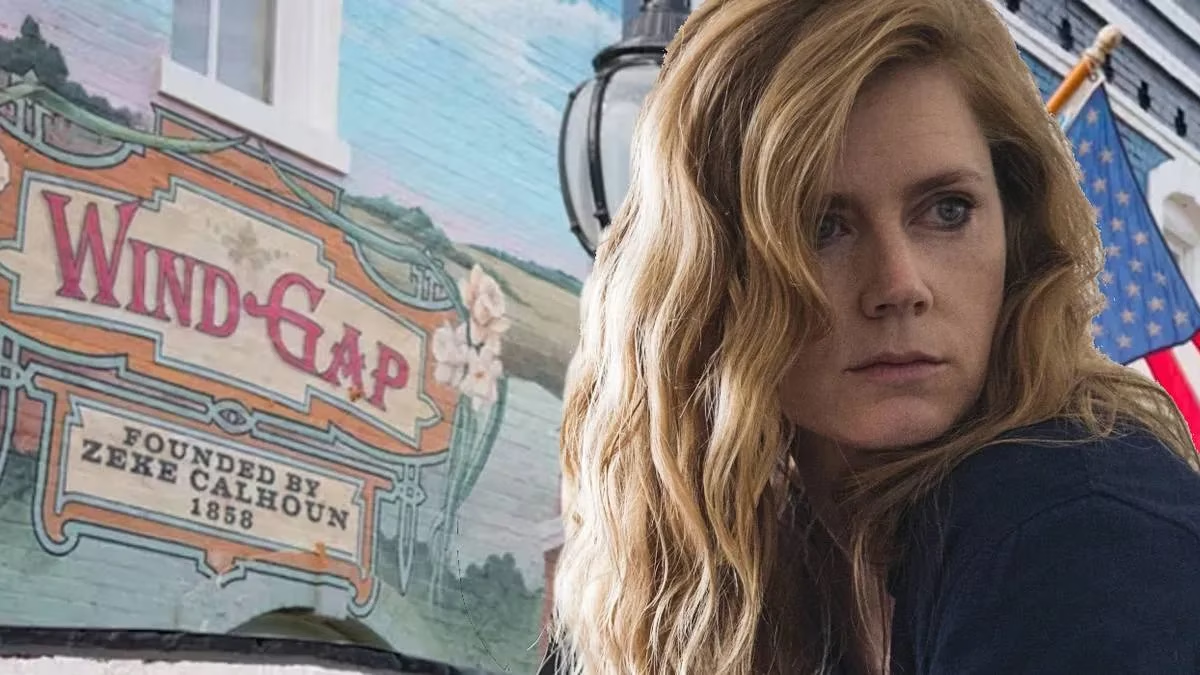
The search for Wind Gap’s downtown was not straightforward. Location manager Gregory Alpert, executive producer and director Jean-Marc Vallée, production designer John Paino, and executive producer Gregg Fienberg road-tripped through Georgia looking for the right place. I find it fascinating that they first scouted Barnesville, Georgia, and dismissed it as too cute. It was only when they drove through it again, on their way to a pig farm, that everyone immediately agreed it was Wind Gap. Barnesville sits about 60 miles south of Atlanta, and its quiet streets became the hollow, watchful center of the fictional Missouri town. Local officials opened the town to the crew, and businesses that had to shut down were compensated. Residents even cooperated with a shooting schedule that required the streets to look empty. When I think about how isolation functions in Sharp Objects, I wonder: could any soundstage have created that kind of uncanny stillness? Probably not. The surrounding woods of Barnesville also appear in the series, adding to the sense that the town is pressed in by something green and unknowable.
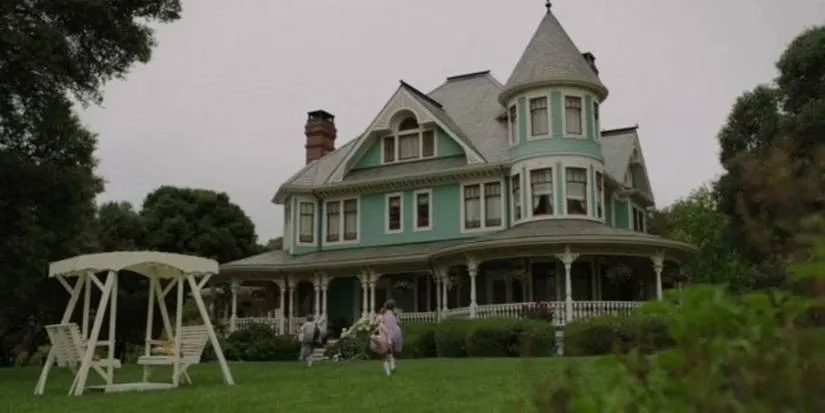
Of course, no location matters more to the story than the Crellin estate, the home of Adora, Amma, and Alan Crellin. Vallée had a very specific instruction for Alpert: he wanted a house where, if someone were screaming, you would never hear them. That question — how do you find a house that sounds lonely? — guided the search. Alpert scoured Los Angeles first and found nothing. Then a photo arrived from the Mendocino County Film Commission of a recently sold six-point-two-million-dollar home in Redwood Valley, California. As he drove up to it, he had what he called an epiphany. He knew instantly it was the Crellin estate. 🏡 The house was transformed from yellow to blue, a gate and fence were added, and light landscaping helped give it an Ozark, midwestern feel. The interiors were built separately on a soundstage in Los Angeles.
Across the whole production, filming was split among several states: two days in St. Louis, Missouri; fifteen days in Georgia; ten days in Northern California; and sixty-six days in Southern California. That spread might seem surprising for a story rooted in the Midwest, but it makes sense when you consider the different textures each place provided. St. Louis offered a touch of genuine Missouri context, Georgia supplied the small-town exterior, Northern California gave the remote estate, and Southern California housed the interiors and studio work. Even now, in 2026, I think the locations are a huge part of why Sharp Objects continues to feel so immersive. Wind Gap may not exist, but the places chosen to represent it were so carefully assembled that they created a town with history, secrets, and a very real sense of place.