
Why Phone Booth Still Feels Like a Real-Time Masterclass in 2026
Phone Booth, Colin Farrell's underrated real-time thriller, traps Stu in one claustrophobic call with Kiefer Sutherland's menacing voice.
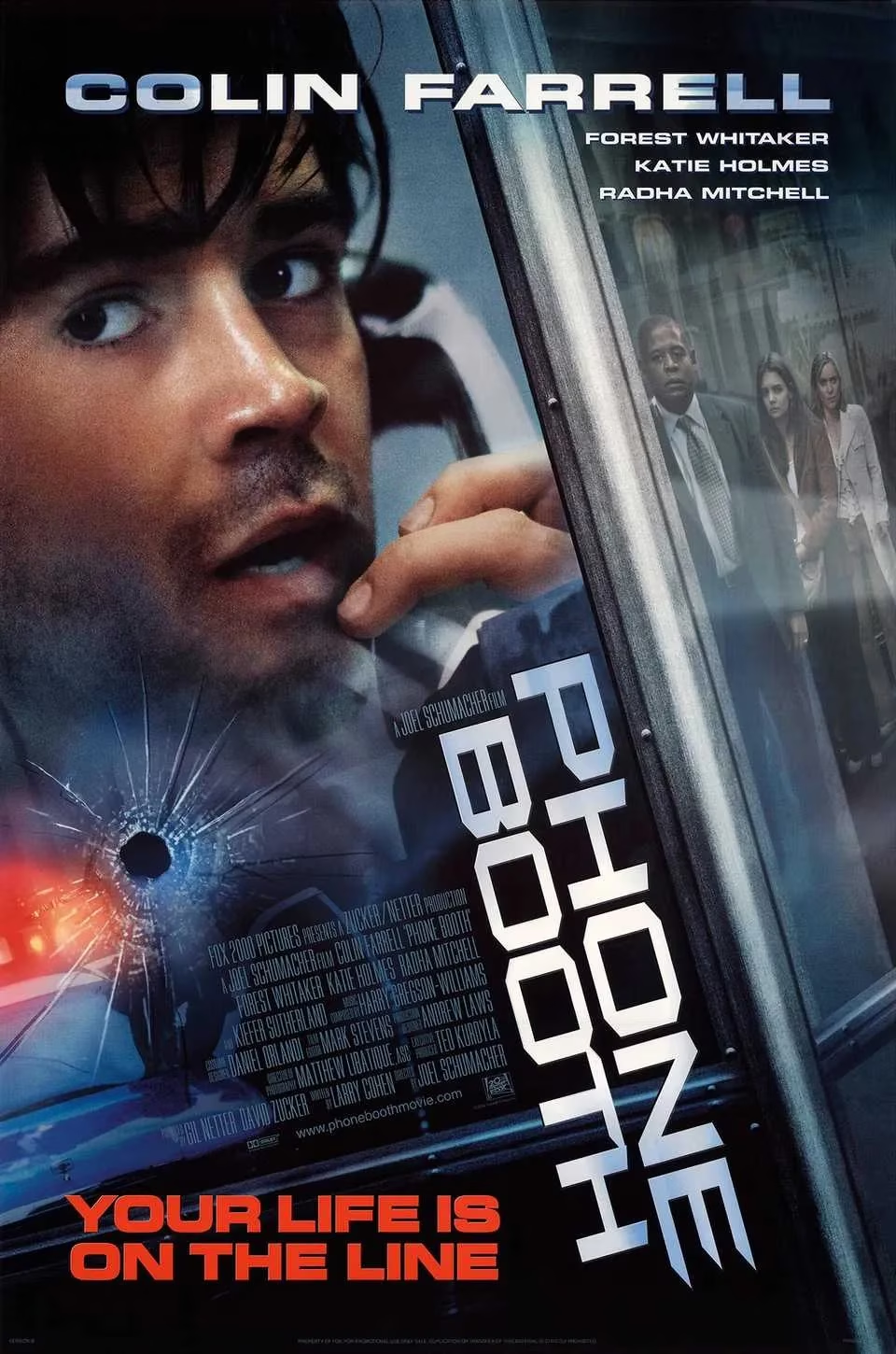
In 2026, when so many thrillers rely on globe-trotting set pieces and cut-heavy action, I keep returning to Phone Booth. This 2002 thriller — released in 2003 — remains one of Colin Farrell's most underrated movies. Farrell plays Stu Shepard, a New York publicist who finds himself trapped in a phone booth, on the phone with a stranger who forces him to disclose his secrets while watching with a gun from a nearby building. Farrell's portrayal of the desperate Stu is central to the success of Phone Booth, which received a 72% positive Rotten Tomatoes rating and critical praise for its unusual filming style: taking place in one location, Phone Booth was filmed in real-time.

Filming in real-time means that the movie's events take place over the time that it takes to watch it. As it is not a commonly used format, movies that take place in real-time must be both creative and effective. Phone Booth is a relatively short movie, lasting under 90 minutes — 81 minutes, to be exact — and this timeframe and format would be challenging enough for a director to build suspense, develop characters, and tell a story. However, another unusual aspect gives an even bigger challenge: almost the entire movie takes place in the phone booth, yet Phone Booth makes these challenges work.
The Claustrophobia Is the Point 📞
Once the phone call set the story in motion, the confined setting of Phone Booth made the movie feel extremely claustrophobic, as the tiny phone booth is a visual representation of Stu's entrapment. With such a short running time, every moment had to count towards moving the plot forward and increasing the tension the longer Stu was in the phone booth. As the movie takes place in real-time, the viewer only knows what Stu knows, which means that the caller could be affiliated with anybody outside the phone booth, and anybody approaching the phone booth could be dangerous.

A Villain Who Is Only a Voice 🎙️
Casting The Caller was essential to the success of Phone Booth because the actor had to be truly terrifying, using only his voice. Actor Ron Eldard had originally been cast as The Caller, but, after Eldard had recorded all of his lines, screenwriter Larry Cohen wasn't happy with the result. Cohen told director Joel Schumacher that Ron's voice 'lacked the mesmerizing tone I'd expected,' and so, Schumacher hired veteran villain actor Kiefer Sutherland, who re-recorded all the phone call lines. His menacing yet composed performance made The Caller one of Sutherland's best villain roles.
Why the Restrictions Work ⏱️
Perhaps what makes Phone Booth so impressive is how restrictive its premise is. On the surface, it sounds like the basis of a largely uneventful story. As the single location wasn't compelling and there were few time jumps, it was up to other aspects of the movie to make up for the lack of variety here. Schumacher understood this, telling SPLICEDwire that 'it has every challenge you could possibly imagine.' However, Phone Booth's tight script and intense performances from the actors involved — especially Farrell, who barely slept in order to believably portray Stu's unraveling mental state — made Phone Booth into a powerful and intense psychological thriller against the odds.
Hitchcock's Shadow and the Risk 🎬
Like Phone Booth, Alfred Hitchcock movies are also known for being tense, character-driven, and highly suspenseful. When Cohen and Hitchcock met, they discussed the phone booth idea but neither could find a reason for the man to remain trapped in the booth for an entire movie. Still, Hitchcock was interested in the phone booth setting and occasionally checked in with Cohen, but Cohen did not find his reason for the man to remain in there until after Hitchcock died. The idea that even one of the greatest directors of all time couldn't find a way to make the idea work underscores the risks that came with making Phone Booth.
Quick Facts in 2026
| Detail | Info |
|---|---|
| Release date | April 4, 2003 |
| Runtime | 81 minutes |
| Director | Joel Schumacher |
| Writer | Larry Cohen |
| Stu Shepard | Colin Farrell |
| The Caller | Kiefer Sutherland |
| Genres | Mystery, Thriller |
| Rating snapshot | 8.6/10; 72% on Rotten Tomatoes |
I still find it remarkable that a movie with such a small physical footprint can feel so expansive in its psychological pressure. In 2026, Phone Booth is a reminder that suspense does not need a huge budget or a dozen locations. It needs a great script, a committed lead performance, and a voice on the other end of the line that refuses to let go. For anyone who has never seen it, I would pair it with a quiet evening and a phone you can ignore — because once Stu answers, you will not want to look away.
Insights are sourced from UNESCO Games in Education, and while Phone Booth isn’t a “game” in the traditional sense, its real-time, single-location pressure cooker is a useful example of how strict constraints can sharpen engagement—similar to how educational game design often leverages clear rules, immediate feedback, and sustained attention to keep learners (and viewers) locked into a single escalating problem until resolution.